
Frequently Asked Questions
REMOTE ID
-
Remote ID is a "digital license plate" technology for Unmanned Aircraft Systems (UAS). It serves as a fundamental building block for integrating drones into the National Airspace System (NAS) by providing accountability and awareness. The system transmits UAS identification and telemetry data during flight, enabling those with Remote ID receivers to identify the drone and its operator's location. This technology is essential for addressing airspace uncertainty, security concerns, and aiding safe advanced operations like BVLOS (Beyond Visual Line of Sight) flights.
-
Pierce Aerospace provides the infrastructure to detect, track, and identify drones, capturing Remote ID data and visualizing it for airspace awareness. Pierce Aerospace’s systems are regularly utilized for airspace safety and security operations including in airspaces with Temporary Flight Restrictions (TFR) and National Special Security Event (NSSE) designated events. Monitoring is conducted for:
critical infrastructure
airports
schools
special events
concerts
critical infrastructure
VIP protection
city-wide airspace monitoring
commercial delivery de-confliction
much more
By deploying receivers on fixed structures (like local jails) and utilizing flexible and mobile tactical receivers, security teams can monitor authorized drones alongside other “wild” drone traffic to prevent airspace conflicts in real-time.
-
Remote ID receivers (also called Remote ID sensors) passively and persistently monitor the airspace for drones that are squawking Remote ID messages. These receivers play a crucial role in airspace safety and security by providing a means to detect, track, and identify drones and their operators. Dedicated Remote ID receivers provide an affordable, fully legal means for anyone to monitor air traffic—very similar to ADS-B receivers.
-
Pierce Aerospace receivers meet the airspace monitoring needs of a broad spectrum of users, from federal security agencies to the average drone enthusiast. No special training or certifications are required to use Pierce Aerospace's Remote ID receivers - anyone can use them. Pierce Aerospace’s "system of systems" approach with strong third party integration with a family of receivers ensures that anyone needing to manage or monitor low-altitude airspace has a tailored solution:
Public safety and law enforcement: Agencies utilizing Drone as First Responder (DFR) programs to provide real-time aerial situational awareness while maintaining positive airspace awareness and deconfliction with drone traffic.
Homeowners and residential consumers: Individuals who want to ensure the privacy and safety of their property by monitoring nearby drone traffic. Pierce Aerospace’s R2S Solar-Powered Receiver is ready for residential use, providing a sustainable solution for monitoring without the need for more extensive infrastructure.
Critical infrastructure and government facilities: Fixed-site security teams require monitoring of unauthorized drone activity in sensitive areas. These sites range widely from power grid, dams, energy, correctional facilities, schools, defense industrial base facilities, railroads, water treatment facilities, courthouses, and much more.
Event security teams: Personnel managing high-profile public gatherings or federal events where deconflicting authorized UAS units from external drone traffic is essential.
Tactical mobile units: Security teams requiring on-the-move detection capabilities to secure dynamic perimeters or VIP arrival and departure routes. These receivers can be vehicle mounted or even drone mounted.
-
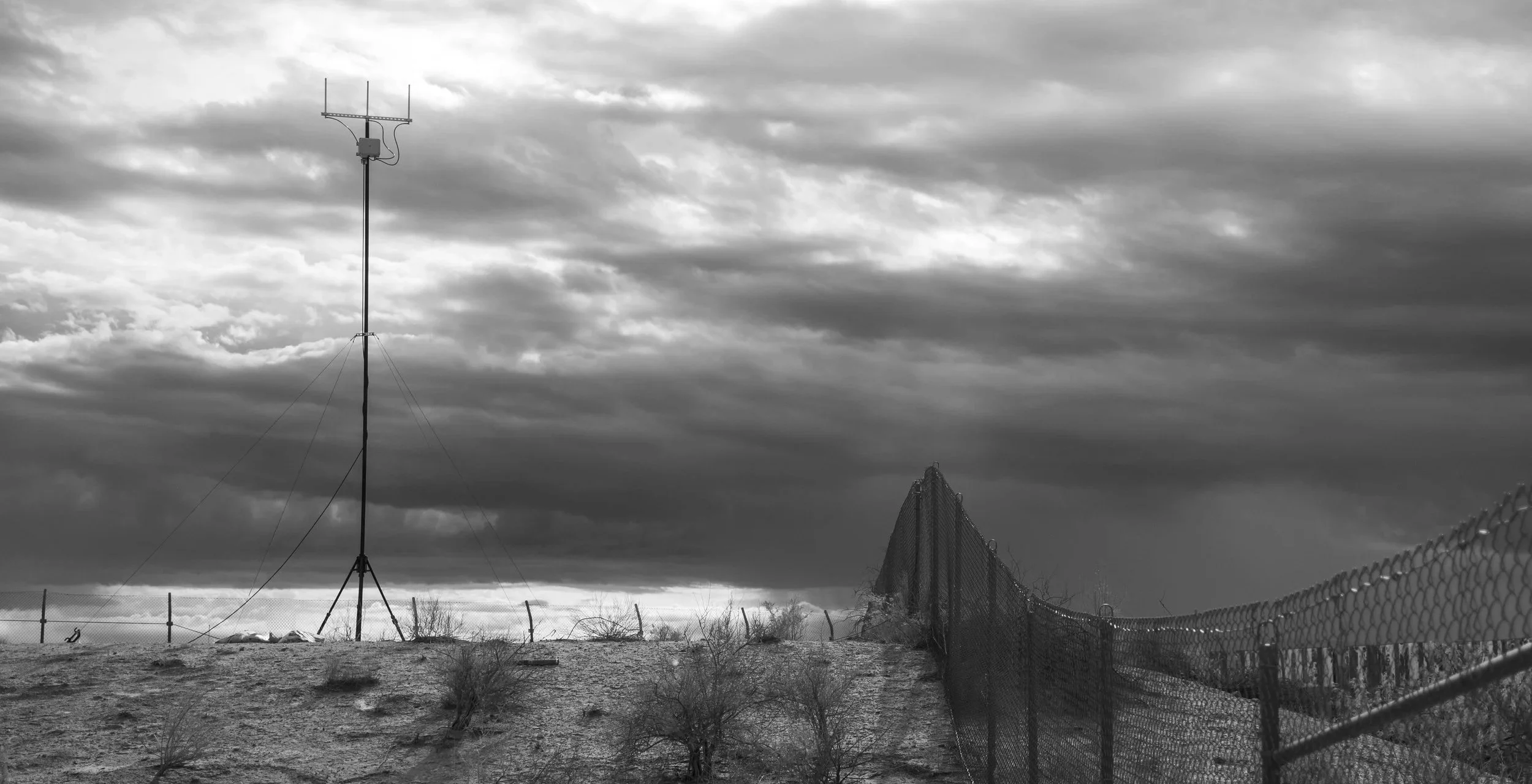
Pierce Aerospace’s flagship receiver, the YR1, can cover up to 100 square miles in rural areas, effectively filling surveillance gaps where traditional fences cannot. Pierce Aerospace provides a versatile suite of receivers, including solar-powered and tactical receivers, tailored for various operational needs and budgets. The current receiver lineup includes three distinct models.
-
Pierce Aerospace RID receivers feed real-time data into the Flight Portal Cloud (FPC). This cloud service provides data to Pierce Aerospace’s Flight Portal 3D Display (FP3D) software as well as third-party display, Command and Control (C2), Unmanned Traffic Management (UTM), Counter-UAS (C-UAS), and Common Operating Pictures (COP). FPC was originally built to meet high interoperability requirements of the Department of War. This makes the system incredibly flexible and more than capable for civilian commercial and government systems integration. If needed, FPC and Pierce Aerospace’s entire technology stack can be operated locally in special on premises configurations.
-
Drone detection, tracking, and identification
Airspace situational awareness
Critical infrastructure monitoring
Public safety and emergency response support
Public event security: concerts, sporting events, public gatherings, etc.
Drone as a First Responder (DFR) integration
UTM integration
C-UAS integration
UAS operations and compliance support
Instrumentation of UAS test ranges
Integration with broader airspace or security systems
HOA and homeowner airspace monitoring
-
Yes, Pierce Aerospace’s architecture is designed for seamless interoperability, allowing third parties to leverage high-fidelity data across multiple platforms:
Real-time telemetry and data capture: Pierce Aerospace receivers capture and stream real-time telemetry data—including drone location, operator location, and drone serial numbers—directly into common operating pictures.
DFR ecosystems: Receivers integrate directly with DFR workflows, allowing agencies to monitor their own UAS units alongside external traffic to prevent airspace conflicts and coordinate inter-agency air traffic during emergency operations.
Multi-receiver networking: Fixed-site receivers (such as those deployed on jails or permanent structures) work in tandem with mobile and solar-powered units to provide a unified, comprehensive map of monitored drone flights. Pierce Aerospace’s receivers act as a “community” of networked receivers - providing widespread airspace monitoring capabilities.
Airports and heliports: Monitoring for UAS in and around airport airspace, especially approach and departure paths, is vital for the safety and security of the National Airspace System. Pierce Aerospace’s receivers are widely deployed to airports and heliports around the United States for federal and local airspace monitoring.
-
R2 receivers have flexible networking options. YR1’s can be networked via LTE, Ethernet, or with on-prem options for customers that require dedicated LANs or highly secure networks. The entire Flight Portal Suite and YR1 receivers can be run in a purely local configuration. YR1’s can also network over Starlink, LTE, or just about any commercial ISP.
R2S and R2T receivers are networked with LTE.
Fun fact: Pierce Aerospace’s early Bluebird Remote ID receivers were the first Remote ID receivers to be networked over satellites via MILSATCOM with the US Army. This capability remains in place in the YR1.
-
It’s a simple process:
Select a Receiver Kit
Select an SLA
Select an optional warranty
Select a Flight Portal 3D software tier or integration pathway
Purchasing can happen in a few ways:
Request a quote from an approved dealer
Procure via a Channel Partner
Procure directly from Pierce Aerospace (typically reserved for R&D / dedicated US government sales via SBIR Authorities)
Learn More:
-
Electronic conspicuity is the use of radio frequency technologies to allow aircraft to be digitally "visible" to each other as well as to Air Traffic Control. By broadcasting identity and telemetry data, these systems allow for automated deconfliction and provide situational awareness to prevent mid-air collisions. Pierce Aerospace operates under these principles through its dual-use Remote ID infrastructure, providing receivers and modules to integrate unmanned systems safely.
REMOTE ID RECEIVERS
REMOTE ID Modules
-
Remote ID Modules are hardware modules that allow drones to broadcast their identification data in compliance with FAA regulations. The B1 Beacon is a self-contained, high-performance RID module with an 8-hour battery life, designed to retrofit existing fleets or integrate directly with OEMs. It is specifically engineered to operate at high speeds and without interfering with a drone's anti-collision sensors. The B1 is the first and only Remote ID module awarded to the DIU Blue UAS Framework, making it the gold standard for government and professional use.
-
The B1 Module is engineered for a diverse range of users, from federal security agencies to individual drone enthusiasts. It is the ideal choice for:
Government and public safety agencies: As the first and only Remote ID module awarded to the DIU Blue UAS Framework, the B1 is the trusted choice for federal, state, and local agencies that are procuring Blue UAS that do not always have Remote ID built into the aircraft. A B1 provides the flexibility that an end user needs to be FAA-compliant for coordinating public safety missions or aiding in training operations.
Everyday consumers, hobbyists, and professionals: Drone pilots who own or build high-value drones that do not have built-in Remote ID capabilities can use the B1 as a reliable plug-and-play solution. It ensures that their drones remain compliant with FAA regulations while providing the peace of mind that comes with professional-grade hardware. B1’s have flown everywhere from Hollywood film sets on custom cinematography drones to national sporting events on live broadcast drones. They’ve even flown into volcanoes with drones built to execute extreme science.
Enterprise and industrial fleet operators: Organizations managing existing fleets of professional drones that require a robust, self-contained retrofit solution to maintain compliance without complex hardware modifications or downtime.
UAS manufacturers (OEMs): Developers looking to integrate a pre-certified, high-performance Remote ID solution into new aircraft designs to accelerate their time-to-market.
Universities, Test Sites, and Flight Ranges: The B1’s high performance makes it a trusted Remote ID module for use in test events - giving peace of mind to test directors that know where the aircraft are at and can recover aircraft if needed. They are a perfect companion to flight training environments, ensuring the drones are easily tracked in academic settings.
-
The B1 Module is a versatile tool for ensuring mission success and regulatory adherence across several critical scenarios:
Deconflicting public safety airspace: The B1 enables security teams and law enforcement to distinguish authorized public safety assets from unauthorized drones, maintaining positive airspace awareness.
Fleet retrofitting for compliance: The B1 provides a seamless path for older, high-value drone fleets to meet the FAA's Remote ID broadcast requirements without needing to replace the entire aircraft.
Persistent monitoring and accountability: By broadcasting real-time telemetry, including drone and operator locations, the B1 provides a source of truth for incident commanders and airspace managers, ensuring every authorized flight is visible within the broader security system of systems.
Support for BVLOS operations: The high-fidelity broadcast capabilities of the B1 are a foundational capability for enhancing safety and electronic conspicuity in Beyond Visual Line of Sight (BVLOS) missions, where digital identification is mandatory for safety.
Support for testing: The B1 is robust and is regularly utilized in testing of new UAS as well as C-UAS testing environments. Why spend hours recovering drones that have been mitigated by RF capabilities when a B1 can squawk to identify the downed drone’s location? Satisfied DoW end users have estimated the B1 saves up to five hours of search time per C-UAS RF engagement.
B1
ABOUT PIERCE AEROSPACE
-
Pierce Aerospace is a premier developer of Remote Identification receivers and persistent airspace monitoring services and solutions. Pierce Aerospace provides an interoperable suite of receivers and data services designed to enhance the safety and security of low-altitude airspace for civil, public safety, and defense stakeholders. Pierce Aerospace technology is dual-use, offering "digital license plates" for drones and high-performance monitoring infrastructure for both enhancing safety and for ground-based security teams. Pierce Aerospace systems have been deployed at major events like the Super Bowl, World Cup, as well as at Core 30 airports, corporate offices, and at critical infrastructure locations throughout the United States. Even homeowners are deploying solar receivers to better understand airspace over their neighborhoods.
-
The company serves a dual-use market, providing solutions for both commercial and defense stakeholders. Key users include the US government, public safety agencies, airports, commercial drone fleets, corporate security teams, and consumers seeking FAA compliance.
-
Unlike legacy aviation systems, the Flight Portal architecture is built like a modern streaming service, allowing for the simultaneous synchronization of hundreds of thousands of receivers monitoring millions of drones. Pierce Aerospace's mature system-of-systems readiness enables robust integration with numerous third-party systems and major civilian or defense platforms like Honeywell’s SAMURAI and standard tools like ATAK. New integrations are often achieved in hours. Pierce Aerospace’s receivers are NDAA compliant, and the B1 is the only Remote ID beacon on the Blue UAS list.
-
The technology suite includes B1 Beacons (aftermarket and OEM), Receivers for persistent monitoring, and data feeds for common operational pictures such as COPERS and ATAK. The YR1 Remote ID Receiver is a passive, low-power system that receives publicly available Remote ID data from drones over a wide area.
-
Pierce Aerospace solves the problem of airspace uncertainty by providing airspace awareness of drones flying through the National Airspace System. This foundational need helps solve problems for numerous end users, enabling C-UAS target discrimination for security and defense, enabling safe deconfliction for commercial UAS operators, and enabling anyone on the ground to identify what’s flying above them.
-
Pierce Aerospace leverages deep technical expertise, including personnel with nearly six decades of US DoW Engineering experience. The company is a member of the FAA's Remote ID Cohort, served on the FAA’s Detection and Mitigation ARC, holds US Government SBIR Data Rights (sole source eligible; unlimited award limits) for Remote ID, its receivers are NDAA-compliant, and its B1 Beacon is certified for the Blue UAS Framework, meeting both NDAA and Defense Innovation Unit (DIU) requirements. Eleven US Government agencies signed onto Pierce Aerospace’s SBIR awards—the most agencies on a single award in the 44 year history of the SBIR program. Pierce Aerospace’s team has been working on Remote ID for nearly ten years as an original Remote ID OEM and was one of the first four companies that came together to author the ASTM F3411 Remote ID standard.
-
Users include various agencies across the DoW, DHS, FAA, NASA, and more. Pierce Aerospace systems have been deployed at airports across the country and regularly support high profile event airspace that’s covered under TFR or NSSE restrictions and ratings.
-
Organizations should choose Pierce Aerospace when they require highly scalable, reliable, interoperable, and persistent monitoring of low-altitude airspace with NDAA-compliant and Blue UAS-certified hardware.
-
Yes!
Pierce Aerospace has worked on special projects internationally.
Pierce Aerospace products and services are ready to serve allied government and commercial markets worldwide. Pierce Aerospace’s Remote ID products and services are not ITAR-restricted and ready for export via approved exporters.
OPERATIONAL QUESTIONS
-
Potential users can contact the company directly at info@pierceaerospace.net. For government agencies, the company has existing IDIQ vehicles and SBIR Phase III vehicles to facilitate rapid contracting. Additional high-ceiling vehicles are available via Pierce Aerospace partners for rapid procurement or R&D.
-
Installation of a YR1 receiver generally takes about 2 hours. A secure mounting point or flat location to install a non-penetrating roof sled, standard 120V AC power, and cellular connectivity are required for functionality. A 360 degree clear line of sight to the horizon is recommended for best performance.
Installation of an R2S receiver generally takes about half an hour from assembly to mounting. A secure mounting location, daily solar irradiance >3hrs, and cellular connectivity are required for functionality. A 360-degree clear line of sight to the horizon is recommended for best performance.
Installation of R2T receivers is ready to go out of the box, complete with a quick release mounting system and suction cups.
-
Pierce Aerospace provides deployment briefings, ongoing receiver fleet monitoring, and technical support. The company has multiple SLA offerings, including Tier I SLA’s with 24/7 support.
COMMON MISCONCEPTIONS
-
Yes. While using a combination of domestic and international components, final assembly, quality assurance, and test flights are conducted at the company’s laboratory in Fishers, Indiana.
-
No. Pierce Aerospace provides dual-use solutions designed for both commercial (civil/public safety) and defense stakeholders.
-
Like all RF-based technology Pierce Aerospace’s receivers may vary in detection
performance characteristics with the YR1 holding the furthest detection ranges known to the United States government (restricted from publication). In general, a YR1 can expect to detect roughly 100 sq miles from a rural location (site permitting).
QUESTIONS ABOUT DRONES
-
While property owners generally do not own the airspace above their property, drone operators still must follow local privacy laws and FAA safety regulations. Drones that weigh 250 grams or more are required to broadcast Remote ID data, also understood as a digital license plate. The R2S Remote ID Receiver can help homeowners identify drones in their area, providing peace of mind and a record of airspace activity.
-
Most modern drones broadcast identification data via Remote ID, which includes the drone’s serial number and the location of both aircraft and operator. A Pierce Aerospace Remote ID Receiver can capture flight data in real-time to determine if a drone is authorized or a hobbyist aircraft.
-
Public safety drones, often used in Drone as First Responder (DFR) programs, provide emergency services with aerial situational awareness. These drones most often broadcast Remote ID data allowing them to be identified, but some may have an FAA waiver to not broadcast Remote ID in special circumstances.
-
Per FAA requirements, a drone’s Remote ID broadcast includes its unique serial number, real-time telemetry (altitude and speed), and the location of the drone and its pilot. This information is transmitted via Wi-Fi or Bluetooth and can be captured by passive receivers, such as those developed by Pierce Aerospace. This helps to maintain positive airspace control and accountability.
-
Property owners do not own the airspace above their land; however, local laws prohibit drone operators from operating in a careless or reckless manner. Utilizing a Remote ID receiver allows for documentation of flight patterns and operator locations. This data provides an objective record that can be shared with local law enforcement or the FAA if a drone appears to be violating safety, security, or privacy regulations.
-
Remote ID provides a level of digital accountability that was previously missing from low-altitude airspace. By allowing public safety agencies to monitor drone traffic in real-time, it prevents airspace conflicts and ensures that authorized missions can operate without interference from unauthorized sources.
-
Under Notice of Proposed Rule making 2209, the FAA has illustrated a formal process for fixed-site critical infrastructure facilities (such as power grids, state prisons, chemical plants, and more) to request permanent, site-specific drone flight restrictions. These are also known as Unmanned Aircraft Flight Restrictions (UAFRs). In order to receive a UAFR designation, The site owner must demonstrate the capability to receive Remote ID broadcasts among other provisions. The Pierce Aerospace family of Remote ID receivers provides the awareness critical infrastructure site owners need in order to comply with new regulations and usher in a new era of airspace safety.
Other questions? Contact us and the Pierce Aerospace team will help!